
All About Dentures
At the clinic, I pride myself on producing hand made and truly custom dentures. I perform all clinical procedures, and my assistant and I perform all laboratory work ourselves. With that said, I know what it takes to have a successful outcome with removable prosthetics, and what the limitations are. Whether you're a newcomer to dentures or an old pro, read on to learn some good pertinent information.
Immediate/Temporary Dentures
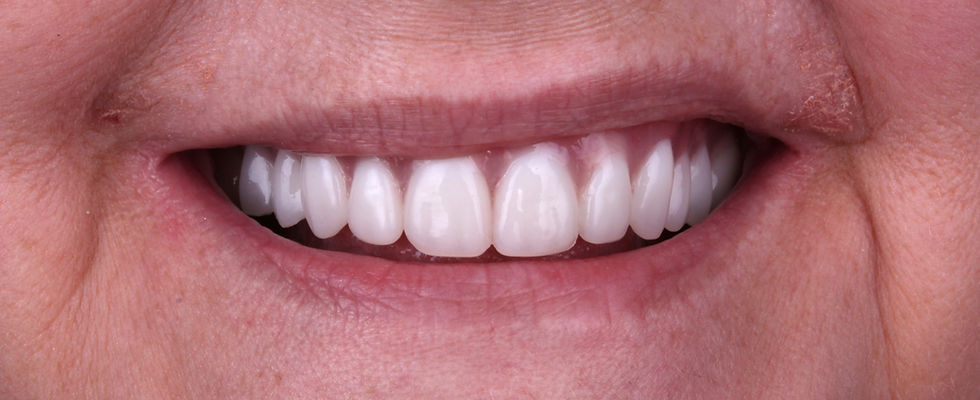
Immediate Dentures are meant as a band-aid. These are made when you still have teeth or right after surgery, in order to have something when you have your teeth extracted. We take impressions and use them to make the prostheses to be ready on the day of extractions. They usually do not fit very well due to swelling and inflammation as a result of the extractions, therefore I will typically reline them with a pink soft liner on the day of surgery, and then around two weeks later (depending on healing) again. Adhesive is usually required, but only after sutures are gone. The major changes that you will notice between natural teeth and dentures are as follows:
-
The palate: you will notice that your tongue hits the roof of your mouth differently, and your speech will be affected. This typically normalizes after around 2-3 weeks.
-
Excessive saliva (drooling): the body is used to having only food items be in your mouth, therefore a ‘foreign body’ e.g. a denture will be sensed as food by your mouth, which will cause drooling. This typically goes away after 2-3 weeks.
-
Gagging: The upper prosthesis will need to cover part of the back of your mouth; some people have a mild to severe gagging reaction. Sometimes this goes away but in people with a severe gagging reflex, implants to remove the palate way to get around this. You will probably know prior to have upper dentures if you are a ‘gagger’.
After a period of healing which is typically around 3 months, we will begin the fabrication process for your definitive prostheses as described below. If implants are placed at the time of extractions, the implants will need to be ensured to be fully healed before fabricating final prosthetics.
Complete Dentures
Complete dentures are not a replacement for teeth. They are a replacement for not having teeth. Millions of Americans function very well with complete dentures. We fabricate every aspect of our complete dentures in house and follow a classic workflow for optimum success. Typically, an upper denture enjoys a ‘suction cup’ effect, which leads to high levels of comfort and satisfaction. A lower denture will have more issues, especially with retention. Many people complain that their lower dentures ‘float’ or ‘ride up’. This is usually due to the basis of retention of the lower denture: your facial muscles and your tongue. It takes a lot of practice and dexterity to help a lower denture ‘stay in’ when eating or talking. I'll help you through this process, but there are severe limitations to lower dentures without implants. For this reason, I usually plan at bare minimum two implants on the lower jaw to partially stabilize a lower denture.
Appointments For Dentures
-
Initial impressions: either with an optical scanner or the 'messy stuff'
-
Final Impressions: the initial impressions are used to make special trays that give an accurate result. It's important not to wear your existing prosthetics starting the night before to give your gums a chance to 'relax' for the final impression.
-
Bite Records: Dr. Buie makes wax prototype dentures that he molds and changes in your mouth to provide a framework for where to place teeth. This is critical; there are many parameters that are examined and done in order to appropriately arrange teeth. A bite record is then taken.
-
Tooth Try-in: Teeth have been set in wax at this appointment, and a verification of the arrangement and color of the teeth is made, with the patient’s final approval being the go-ahead for the next step. It’s important to note that after this appointment, no changes can be made to the teeth.
-
Insertion: The insertion appointment is when the patient receives the final prosthetics. We will paint a paste on the internal aspect and grind off areas that will cause sores and check the bite. I normally obtain around 75% of bite adjustments at this appointment, but wait until follow ups to see how your facial muscles adapt to a new prosthetic to ‘spot in’ the bite.
-
Adjustments will be carried out after the insertion appointment. We usually see patients back after one to two days, five to seven days, and two weeks after the denture insertion to adjust sore areas and the bite. As a courtesy, we perform the first three adjustments as part of your treatment, and after three appointments we charge a small fee for further adjustment appointments.
21 Day Rule: I may talk with you about the 21day rule, which is where we give the patient 21 days to accommodate to removable prosthetics without implants to see if prosthetics without implants are feasible. Many patients, especially if this is their first set of removable prosthetics, will find that after the first 21days, they may require implants on the lower arch, and may not require any implants on the upper arch. Instead of making that determination before, we like to see if patients can tolerate upper and lower dentures without implants before doing further surgical or prosthetic procedures. I may talk with you regarding this if, based upon your mouth and his experience, we recommend implants.
Lower Denture Difficulties
Many patients cannot accommodate to a lower denture without implants, as our mouths were not designed to retain such a prosthetic. You may have excessive sore areas and your prosthetic may not ‘fit right’ even though it’s brand new and perfectly adapted to your jaw. This is normal! Many times placing two implants will completely alleviate this problem, but you should consult with us to see what we recommend first.
Next Steps
I believes in treating every patient like family. Many patients can tolerate removable prosthetics very well, even without implants, but I am a trained Specialist in Implant and Prosthetic Dentistry. With this level of expertise, if you require further retention or confidence in your smile, we can provide implant services and the prosthetics that go with them, including overdentures (snap on) and hybrids (permanent dentures).